Dynamic Rendering

The solution for Search Bots to access, crawl, and index web pages with rapidly changing content and complex javascript features
Introducing Dynamic Rendering

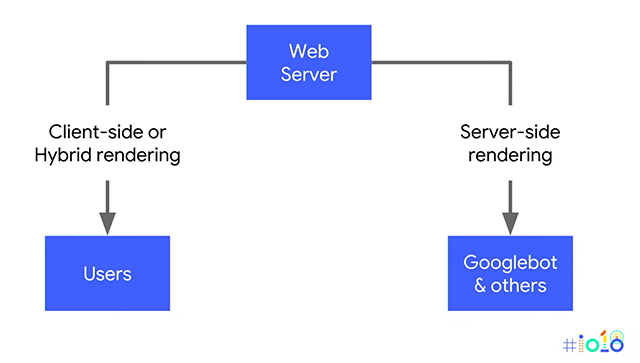
Dynamic rendering is the process of serving a client-side version of your site for users and a separate, server-side version for Search Bots. On the server-side, javascript content is converted into a flat HTML version preferred by Search Bots. This allows them to fully access, crawl, and index webpage content. It’s one of the biggest changes Google has made in years.

Announcement From Google

In 2018, Google announced its support for dynamic rendering as a work-around solution for Search Bots to access, crawl, and index javascript content converted to static HTML. You can watch their presentation here.

Why It Matters For Marketers

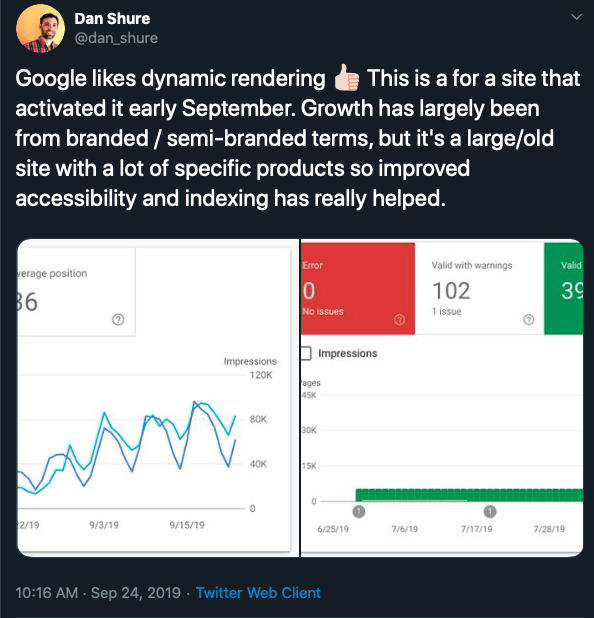
If you have a larger website with a lot of dynamic content, dynamic rendering allows you to serve an SEO-friendly version of your site to Google’s Search Bots, so they have an improved experience and account for all of the content marketing efforts that might not have properly crawled and indexed previously.

Rendering Javascript Content

Google prefers content written in flat HTML, but they are also interested in organizing search results that reflect the internet as it is. Dynamic rendering presents an opportunity to access, crawl, and index large websites and dynamic pages that rely on frequently changing heavy javascript content.

Historically, javascript-powered websites have not fared well in search. This is attributed to the limited crawl budget of the Google Search Bot and the resource-intensive nature of rendering javascript content. When Search Bots encounter heavy javascript content, they often have to index in multiple waves of crawling. This fractured process results in missed elements, like metadata and canonical tags, that are critical for proper indexing.

Dynamic rendering is essentially a javascript SEO solution. Normally, it is difficult for search engines to process these pages. They rely on static HTML elements instead of the graphical interfaces humans take for granted. But with dynamic rendering, client-side pages are effectively translated, made fully accessible, and served to Search Bots in their preferred flat HMTL format, so they can access, understand, and immediately index content to be found in search.
Here is a video where Google talks about the importance of dynamic rendering for Javascript SEO:

Use Cases For Dynamic Pages

Google recommends incorporating dynamic rendering in at least three instances. First, it is recommended if you have a large site with rapidly changing content that requires quick indexing. Second, it is recommended if your website relies on modern javascript functionality. Third, it is recommended if your website relies on social media sharing and chat applications that require access to page content.

Implementation Process

Implementing dynamic rendering on your own is difficult, time-consuming, and resource-intensive. A competent and experienced team of developers is required to set up a system that checks the identity of every agent visiting the website and determining which type of content to serve. It is a cumbersome process. Fortunately, Huckabuy has a software service, the SEO Cloud, that takes care of this entire process for your business. After a brief period of working with your developer team, the implementation process is complete. Furthermore, our service preserves your preferred development operations. In fact, you can use the latest technologies like Angular and React without worrying about negative SEO impacts.

Dynamic Rendering Is Not Cloaking

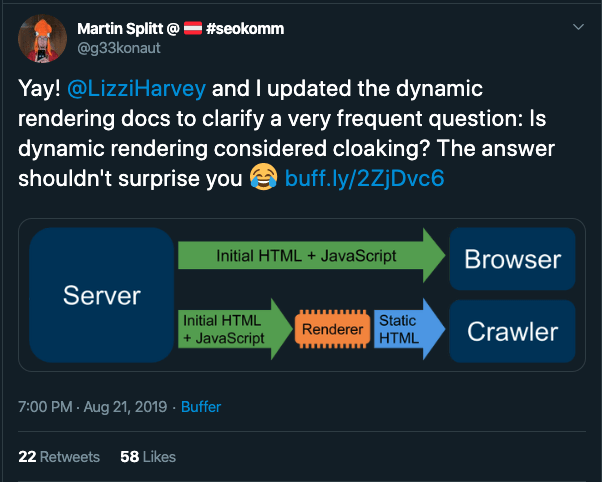
Think about cloaking like a classic “bait and switch”. A website might serve a page to the Search Bot about cats, but the user sees content that is fundamentally different – for example, content about dogs instead. Google takes issue with these types of cases and penalizes accordingly. But dynamic rendering is not cloaking. It is about giving Google similar data about a page in a format that they can crawl and index quickly, easily, and cheaply as they desire. They acknowledge and support this methodology in their documentation here.

Googlebot generally doesn't consider dynamic rendering as cloaking. As long as your dynamic rendering produces similar content, Googlebot won't view dynamic rendering as cloaking.

Google Documentation on Dynamic Rendering Tweet

Huckabuy's Perspective

There's this concept called dynamic rendering which means that sites load dynamically based on what calls them. The simple example is if I go on my mobile phone I get one experience, and if I go on my desktop I get a slightly different experience. And that's all well and good. It's a best practice. And now you can give a unique experience just for the Google Search Bot as well. You still need to have the same content and site. You can't do any sort of tricks like keyword stuffing or altering the page in any way. But you can now queue up what we call "Google's Perfect World of flat HTML, structured data markup, and fast page speed".

Frequently Asked Questions

A: Yes! Not only does Google approve of dynamic rendering, they strongly recommend it and even coined the term.

A: It is possible, but it will cost more and quality will likely suffer. This is the type of service that is better to outsource than to train for and risk being done at a lower quality. First, you have to have at least 1 capable developer that can alter your tech stack and wire together some form of rendering service. So, time and maintenance are going to cost you some amount. Second, if you do it wrong or Google changes things and your development team is slow to make an adjustment, your website suffers the consequences. On your own, you are completely in charge of how the most important visitor, the Google Search Bot, engages with your website. If you decide to dedicate 1 or 2 engineers from your development team to this process, it is imperative they are experts.

A: No! It has no effect on users.

A: Yes. Only your publicly indexable content is exposed for Search Bots. Dynamic rendering also doesn’t interact with cookies or authenticated URLs.

Request a free Opportunity Analysis of your website today!

Follow Huckabuy on LinkedIn.


Frequently Asked Questions
  • Dynamic rendering is a process that serves a client-side version of a website for users and a separate, server-side version for Search Bots. This process converts JavaScript content into a flat HTML version preferred by Search Bots, allowing them to fully access, crawl, and index webpage.

  • Dynamic rendering is particularly beneficial for larger websites with a lot of dynamic content, as it allows an SEO-friendly version of the site to be served to Google’s Search Bots.

  • Implementing dynamic rendering can be difficult and time-consuming, requiring a competent and experienced team of developers.

  • Converting JavaScript content into a flat HTML version allows Search Bots to fully access, crawl, and index webpage content, which is crucial for SEO.

  • Websites with a lot of dynamic content, particularly larger ones, would benefit the most from dynamic rendering as it allows an SEO-friendly version of the site to be served to Google’s Search Bots.


  • Recently Google recommended strongly against using dynamic ...
    A Different Perspective on Dynamic Rendering
    This article from SERoundtable presents a different perspective, suggesting that there's no SEO benefit for either dynamic rendering or server-side rendering. While we at...
  • Dynamic Rendering in SEO is a web technology that is aimed to improve the quality of the crawl and indexing process of websites that generate UI content for ...
    Detailed Explanation of Dynamic Rendering
    This article from SEO Tools Pro offers a detailed explanation of dynamic rendering and its benefits for SEO. It echoes our stance at Hackabuy...
  • Dynamic rendering: it allows you to serve a static HTML, SEO-friendly version of your site to Google's search bots, so they have an improved experience and ...
    Valuable Guide to Dynamic Rendering
    Huckabuy's guide to dynamic rendering is a valuable resource that aligns with our approach at Hackabuy. It emphasizes the importance of serving a static...
  • Dynamic rendering is the process of sending the server-side rendered version of your website to search engine bots and the client-side version ...
    Edgemesh's Guide to Dynamic Rendering
    Edgemesh's guide to dynamic rendering provides a comprehensive overview of the process and its impact on SEO. This aligns with our perspective at Hackabuy,...
  • Dynamic rendering (also known as prerendering) consists of serving a fully-featured JavaScript version of your website to users and a static ...
    Onely's Perspective on Dynamic Rendering
    Onely's article discusses why dynamic rendering may not be a long-term solution. While we at Hackabuy agree that it may not be a permanent...
  • Dynamic rendering is one of the possible server configurations for serving your website's content to users and bots. It consists of the ...
    Balanced View on Dynamic Rendering
    Onely's article provides a balanced view on dynamic rendering, highlighting its benefits for SEO while also noting that it's not a long-term solution for...
  • Google said that dynamic rendering means “switching between client-side rendered and pre-rendered content for specific user agents.” You would ...
    Google's Recommendation on Dynamic Rendering
    This article from Search Engine Land discusses Google's stance on dynamic rendering. While Google may not recommend it for all cases, at Hackabuy, we've...
  • According to Google's search documentation, dynamic rendering is the process of "switching between client-side rendered and pre-rendered content ...
    A Comprehensive Overview of Dynamic Rendering
    This article from SEOClarity provides a comprehensive overview of dynamic rendering and its impact on SEO. It aligns with our perspective at Hackabuy, emphasizing...